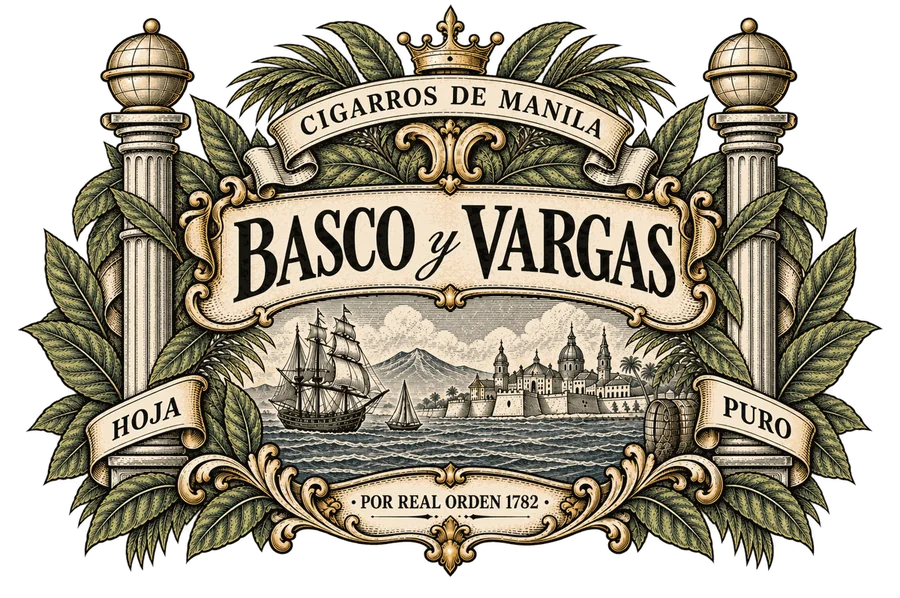
Our seal borrows two pillars and two worlds from a silver coin. People ask why a cigar house would put a coin on its box. The short answer is that the coin paid for Manila, and the ship that carried it carried the seed.
Every year from 1565 to 1815, one or two ships left Acapulco for Manila with a cargo that was mostly silver. Bars and coins from the mines of Zacatecas and Potosí, minted in Mexico City into the real de a ocho, the piece of eight. In Manila the silver bought Chinese silk and porcelain, Indian cotton, spice from the Moluccas, and the galleon turned round. The trip east took three months. The trip back took six, and killed a good share of the crew each time.
In 1580, in the hold of one of those ships, there was a bag of tobacco seed from Cuba. Nobody wrote down which ship. The Augustinian friars planted it in the north of Luzon and it took to the Cagayan valley better than anyone had planned. Two centuries later Governor Basco y Vargas turned that leaf into a royal monopoly, and the monopoly paid the bills of the colony that the silver had been paying until then. That is the whole story in one line: the coin arrives, the seed arrives with it, the seed replaces the coin.
Reading the columnario
The coin we drew from is the version struck between 1732 and 1772, the one collectors call the pillar dollar. Two pillars of Hercules with crowns on top. Between them, two hemispheres under a single crown, sitting on waves. Two mottos on ribbons: Plus Ultra, further beyond, and Utraque Unum, both are one. It is a small, precise piece of propaganda for an empire on two oceans, and it happens to be beautiful.
It was also the first money the whole world agreed on. The piece of eight was legal tender in the United States until 1857. Merchants in Canton stamped it with their own marks and passed it on. The Philippine peso descends from it, and so does the dollar sign, which most likely began as the ribbon wound around the pillars.
What we kept, and what we did not
The seal keeps the pillars, the two worlds and the waves. It replaces the mottos with our own line: Por Real Orden, Estanco de Manila, 1782. That date is the royal order that founded the tobacco monopoly. It is the birth date of the Manila cigar, and it is not ours. The house is new. We say so on the page about the house, and we say it again here in case anyone reads the coin the wrong way.
The crown on the coin, we left on the pillars where it belongs. There is no royal warrant behind this cigar, only a governor's signature from a long time ago and a manufactory in Laguna that still rolls the way his factories did.
The whole seal, the pillars, the coin and the leaf, is explained on the House page.